Nigeria, a country that one’s had the best educational system of sub-Saharan Africa, has now an education sector that is literally falling apart. Falling apart because schools collaps. Luckily some principals don’t allow their pupils to come in to school during rainy weather. But what then? Also the federal government doesn’t seem to mind that schools close for 4 weeks. Elections are more important than education…..
My questions ….. or better to say Lucy’s and my questions are: how come that things deteriorated so much? How come the differences between different states are so enormous? How is responsible for maintaining buildings, writing curriculum, supplying furniture and learning aids? To get an answer to these questions Lucy got suggested that we should go to the Federal secretariat of the ministry of education. So we did.
After a summit for the 10th anniversary of the international year of volunteering we took off to the ministry. In the taxi thinking about how to put the questions and who to talk to, we arrived. A little bit nervous. How do we know where to go? How do we know who is the right person? Where do we start and how do we introduce ourselves? We decided to start to look for the director of schools. So we went to the 6th floor. We popped in the first open door to ask where we could find the director. In 606. There we were directed to 610 and there to the first office we entered. The new directions lead us to the nearby office where somebody was sleeping on the desk. Visualize a head that crashed down by gravity. She told us to go to the third floor, to the director of administration. On the third floor we also visited 3 office and got directed to the eight floor…… or was it the sixth …. again.
In the hallway we decided for ourselves that we had to make a choice. Lucy got the advice to seek it higher in the hierarchical system, the minister of education should know our answers.
Mmmmm, minister …… are we dressed properly? What do we really want to know? Why are we here? New deliberation in the hallway. We took the advice of a lovely lady in the hallway and we went to the ps’ office (Permanent secretary). ‘ He knows everything’: she said.
After entering 2 office and asking if the ps was in we were sent to a waiting room. Nice chairs and a tv + some other people.
Being in Nigeria for a while now, we know that waiting is part of the daily routine. Also the fact that secretaries don’t know anything about the agenda of their ogar (boss) is known by us. But waiting for somebody for more than an hour while he is not in the office is a little bit strange….. surely when it is already 5 o’clock in the afternoon.
All and all after a while Lucy did get the advice to write a letter in which she has to invite herself at the ps’ office ……... After 2 hours waiting.
What did we gain: knowledge about structure of the building, some good practice examples of schools (advertising on tv) and how to find our way in a bureaucratic environment (conversation with lady that also was waiting).
Wednesday, March 30, 2011

Monday, March 7, 2011
no dancing at all.......
Commissioning is a new word that I learned this week. Still don’t know what it means literally, but it has to do something with the official opening of a building. Viola commissioned her project (two classroom school building) on her birthday. The 28th of February 2011 will be a date she won’t forget soon. Almost all invited people came to see the official opening.
 The proud shine on Viola’s face was enough to know that she was happy and satisfied. Nawani Aboki (owner of NACWYCA, chairman of CSACEFA and possible new governor of Nasarawa State) was the proud chairman of the day. In his speech he told us that he was the one whom introduced Uche and Viola to each other. The two ladies had the same dream and he brought those dreams together. Viola wanted to leave a landmark behind after leaving Nigeria and Uche wanted to help out a community. Uche lacked the right skills to pull it off and Viola lacked a place to put her landmark. Together they build the school block for two classrooms in Kurikyo in 4 months’ time. Money came from the German embassy and Viola’s former high school in Germany, labor came from the community.
As Viola is a person who wants to plan things in slight detail the day was well prepared, only in the last moment people wanted to show they are Nigerians and they messed up the how program. They shifted things around and they were adding and scraping things. In the end Viola knew she had to let go and enjoy the whole day just as it would be.
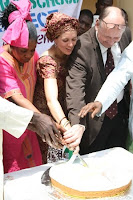 After all official welcomes and speeches, Nawani cut the cord and the man from the embassy, the village head, Uche, Viola and the man from UBEB (universal basic education board) cut the cake, traditional dancers took the floor. Traditional dancers…….. What do you think they are? What do you think they look like? What do you think they do?............... None of your answers is probably right. In Kurikyo they don’t dance, they don’t wear traditional clothes and it is not a mixture of man and women. In this case it was a few guys in the age of 18 till 25 with an old man as their leader. They were wearing normal pants and tiny tops like teenagers sometimes wear and they had big knifes.
Their ‘dance’ was cutting themselves with those knifes in front of the village head and Viola. The old man then gave them some green stuff (looked like Nederwiet) and a razorblade. After eating the green stuff they put the razorblade in their mouth and started chewing. They eat the razorblade!!!!!!
This is no dancing!!!!! This is weird!


As Viola is a person who wants to plan things in slight detail the day was well prepared, only in the last moment people wanted to show they are Nigerians and they messed up the how program. They shifted things around and they were adding and scraping things. In the end Viola knew she had to let go and enjoy the whole day just as it would be.

Their ‘dance’ was cutting themselves with those knifes in front of the village head and Viola. The old man then gave them some green stuff (looked like Nederwiet) and a razorblade. After eating the green stuff they put the razorblade in their mouth and started chewing. They eat the razorblade!!!!!!
This is no dancing!!!!! This is weird!

Monday, February 14, 2011
Learning in Abuja
What does a teacher need to know before you put him/her in front of a classroom? That was the main question I had to ask myself the last few weeks after Christmas. What is important to know? What are the essential basics about teaching?
These questions guided me in organizing a 2-day-workshop for NGVP in Abuja last week (7th and 8th of February). The topics that popped up in my mind were; learning theories, learning strategies, learning ability, learning styles, Bloom, Maslov, pedagogy, personal development, self-reflection on teaching, didactics, effective learning and participation.
So I picked a few of those topics and asked my colleagues to prepare a part of the workshop. So in Kano they had to prepare something about learning in general, learning styles and personal development. I asked Lea from Kwara to prepare the part about active learning and participation. And I prepared the part about pedagogy and classroom/school management. But also an alternative program in case somebody couldn’t be there.
I arrived in Abuja on Friday February 4th to photocopy the handouts and other stuff we needed during the program. We planned to meet in Abuja on Saturday so we would have an extra day for last minute preparation. But like everything in Nigeria, things don’t go as planned. Lea couldn’t come at all and the people from Kano couldn’t come earlier then Sunday because the car wasn’t there on Saturday. So there was nothing else to do then find something to do for myself. Visit Wuse market, get my phone fixed and move from Viola’s apartment to Crystal Palace. In the evening I met Thessa and we went clubbing/dancing at Ibiza. Nice to be in the city!!! Thanks Thessa!
On Sunday I decided it should be a slow day; late breakfast and swimming. And in de late afternoon I did some reading in the lobby of the hotel because all participants should arrive.
It was nice to see all my own NGV’s again after a real long break, but it was also nice to see all the others and the international volunteers.
Monday Marianne and Annabelle started the main sessions about Learning and Learning styles, after a short introduction activity. How the brain works…….. Basic needs before somebody is able to learn anything. Sensory learning like, visual, auditory and kinaesthetic learning. Learning theories like behaviorism, cognitivism and constructivism. All these words should be acracadabra any more for the participants. It was really good and inspiring to see the participants debating the topics. They kept asking questions about the topics even after the day was over.
The next day it was Julian and my turn to perform. I started the day about inclusive education; how do you involve all the children from your classroom in your lesson? What do you need to consider on fore hand? How can you create a learning friendly environment in the classroom and school? All those questions are important to answer before starting teaching.
Julian had the graveyard shift with his session about effective learning. During this session it was really nice to see how Marianne was right about the different learning styles. Julian only addressed to the auditory learners, so the others had problems staying tuned in. Chinedu, as a total visual learner, even fell asleep. Nice moment to reflect on.
Most important for me was the input of the participants, their enthusiasm and the evaluation of the whole training. Most beautiful comments were:
•The lesson/lectures helped me to have interest in teaching more than any other work
•The workshop was full of fun and interesting
•I learned that you people have what it takes! I really feel good.
I was tired but I felt full of new energy after the workshop
These questions guided me in organizing a 2-day-workshop for NGVP in Abuja last week (7th and 8th of February). The topics that popped up in my mind were; learning theories, learning strategies, learning ability, learning styles, Bloom, Maslov, pedagogy, personal development, self-reflection on teaching, didactics, effective learning and participation.
So I picked a few of those topics and asked my colleagues to prepare a part of the workshop. So in Kano they had to prepare something about learning in general, learning styles and personal development. I asked Lea from Kwara to prepare the part about active learning and participation. And I prepared the part about pedagogy and classroom/school management. But also an alternative program in case somebody couldn’t be there.
I arrived in Abuja on Friday February 4th to photocopy the handouts and other stuff we needed during the program. We planned to meet in Abuja on Saturday so we would have an extra day for last minute preparation. But like everything in Nigeria, things don’t go as planned. Lea couldn’t come at all and the people from Kano couldn’t come earlier then Sunday because the car wasn’t there on Saturday. So there was nothing else to do then find something to do for myself. Visit Wuse market, get my phone fixed and move from Viola’s apartment to Crystal Palace. In the evening I met Thessa and we went clubbing/dancing at Ibiza. Nice to be in the city!!! Thanks Thessa!
On Sunday I decided it should be a slow day; late breakfast and swimming. And in de late afternoon I did some reading in the lobby of the hotel because all participants should arrive.
It was nice to see all my own NGV’s again after a real long break, but it was also nice to see all the others and the international volunteers.
Monday Marianne and Annabelle started the main sessions about Learning and Learning styles, after a short introduction activity. How the brain works…….. Basic needs before somebody is able to learn anything. Sensory learning like, visual, auditory and kinaesthetic learning. Learning theories like behaviorism, cognitivism and constructivism. All these words should be acracadabra any more for the participants. It was really good and inspiring to see the participants debating the topics. They kept asking questions about the topics even after the day was over.
The next day it was Julian and my turn to perform. I started the day about inclusive education; how do you involve all the children from your classroom in your lesson? What do you need to consider on fore hand? How can you create a learning friendly environment in the classroom and school? All those questions are important to answer before starting teaching.
Julian had the graveyard shift with his session about effective learning. During this session it was really nice to see how Marianne was right about the different learning styles. Julian only addressed to the auditory learners, so the others had problems staying tuned in. Chinedu, as a total visual learner, even fell asleep. Nice moment to reflect on.
Most important for me was the input of the participants, their enthusiasm and the evaluation of the whole training. Most beautiful comments were:
•The lesson/lectures helped me to have interest in teaching more than any other work
•The workshop was full of fun and interesting
•I learned that you people have what it takes! I really feel good.
I was tired but I felt full of new energy after the workshop
Sunday, February 6, 2011
Ogbagi: Ultimate development work?! 1
When was the last weekend I didn’t travel at all? I don’t remember to be honest. Last weekend I was at least the Saturday in Lafia. I have had my first tennis lesson that morning, knowing that the next lesson wouldn’t be within the next two weeks, because of work and parties. So where did I go this time then? With whom and why?
 Richard, my housemate, is an International volunteer working for an umbrella organization for NGO’s. So he does work for all members in Nasarawa State. One of the NGO’s is fighting for a community school to become a government school. It is the secondary school in Eggon Hills. There are 8 communities in the hills whom together build a secondary school. Right now the communities pay the teachers, all maintenance, books everything. Quite expensive, although the teachers do earn even less then government teachers. The principal, Manasseh, invited Richard to come and visit the school for a second time. This time Manasseh asked him to bring more International Volunteers, so he could pass on the information to other ears and other channels.
 My first lesson that day was about mapping and locating. I drew a map of the world on the black board and asked the pupils of SSS1 and 2 to copy it in their notebooks. They were stunned. They never had to draw something, especially not a map of the world. I could see it in the way they started drawing the continents. Next part of the assignment was locating 6 continents in the map. First question; which continents are there? After the puzzle of naming the continents and putting them on the right spot on the map, I asked them to locate Nigeria, India, The United Kingdom and The Netherlands. Luckily the pupils knew they had to be in Africa but where……… they had no clue. After helping them with a compass, because they knew it was West Africa, a girl could place it in the right spot. Everybody can probably guess that the other countries didn’t end up at the right spot on the map. After explaining why maps and locating are important I moved on to a subject closer to home: Vegetation zone in Africa. As locating is really important at geography, I drew a map of Africa and started drawing the vegetation zones. With every zone I located in the map I told a little story to sketch a picture in the minds of the pupils. They were looking at me as I was speaking Spanish. They were not able to make images in their heads because they had never seen examples of images. A reason for me to get the pupils outside and get them looking around and moving around. I drew the map of Africa in the sand and asked the pupils to move from on zone to the other. In every zone I told them to pretend to be the vegetation in the zone. So, i.e. rainforest with big trees and leafs, making yourself big and arms spread out.
 In JSS1 I wanted to play a game to let them learn the different parts of a flowery plant. I drew a picture of a plant and wanted the pupils to form groups.
 Richard, my housemate, is an International volunteer working for an umbrella organization for NGO’s. So he does work for all members in Nasarawa State. One of the NGO’s is fighting for a community school to become a government school. It is the secondary school in Eggon Hills. There are 8 communities in the hills whom together build a secondary school. Right now the communities pay the teachers, all maintenance, books everything. Quite expensive, although the teachers do earn even less then government teachers. The principal, Manasseh, invited Richard to come and visit the school for a second time. This time Manasseh asked him to bring more International Volunteers, so he could pass on the information to other ears and other channels.
 When was the last weekend I didn’t travel at all? I don’t remember to be honest. Last weekend I was at least the Saturday in Lafia. I have had my first tennis lesson that morning, knowing that the next lesson wouldn’t be within the next two weeks, because of work and parties. So where did I go this time then? With whom and why?
We were supposed to go with 5 international volunteers and some people from local NGO’s, in the end only Richard, Teddy and I took the challenge of a 3 hour walk through Eggon hills. Manasseh, some local kids and a teacher were waiting for us at the start of the trail. The kids were there to carry the pure water, Manasseh to lead the way and encourage us. It wasn’t a simple walk and after a while I was really clad that I did some tracking in Kagoro and Obudu. The views were magnificent!! Around every corner, behind every rock a new surprise.
We started walking around 4 pm and arrived at Manasseh’s house around 7 pm. It’s was just starting to get dark. At the house we installed ourselves in our rooms. Teddy and Richard together in a room that was built for teachers to come and stay. Not yet finished but a nice way to make the stay for a teacher more comfortable. I did get a room in the house, probably the room of Manasseh’s oldest son. That night was an early night. Exhausted!!!
On Monday morning Manasseh gave a briefing of what he wanted us to do at the school. As we were planning on staying for 2 days we could take our time to observe the teachers today and maybe prepare some lessons. Then we could give some lessons in the afternoon or on Tuesday. When we arrived in the school around 8 am there was only 1 teacher present. 1 teacher for secondary school and none for primary school!!! Problem! Change of plans: If we please could arrange some lessons for this morning. No big problem for me, as I am a teacher, slightly bigger problem for Teddy and Richard. Luckily they could find some quick maths to teach. At the same time a good way to check the level of maths.
 My first lesson that day was about mapping and locating. I drew a map of the world on the black board and asked the pupils of SSS1 and 2 to copy it in their notebooks. They were stunned. They never had to draw something, especially not a map of the world. I could see it in the way they started drawing the continents. Next part of the assignment was locating 6 continents in the map. First question; which continents are there? After the puzzle of naming the continents and putting them on the right spot on the map, I asked them to locate Nigeria, India, The United Kingdom and The Netherlands. Luckily the pupils knew they had to be in Africa but where……… they had no clue. After helping them with a compass, because they knew it was West Africa, a girl could place it in the right spot. Everybody can probably guess that the other countries didn’t end up at the right spot on the map. After explaining why maps and locating are important I moved on to a subject closer to home: Vegetation zone in Africa. As locating is really important at geography, I drew a map of Africa and started drawing the vegetation zones. With every zone I located in the map I told a little story to sketch a picture in the minds of the pupils. They were looking at me as I was speaking Spanish. They were not able to make images in their heads because they had never seen examples of images. A reason for me to get the pupils outside and get them looking around and moving around. I drew the map of Africa in the sand and asked the pupils to move from on zone to the other. In every zone I told them to pretend to be the vegetation in the zone. So, i.e. rainforest with big trees and leafs, making yourself big and arms spread out.
 In JSS1 I wanted to play a game to let them learn the different parts of a flowery plant. I drew a picture of a plant and wanted the pupils to form groups.
 · Culture shock one:Kids didn’t move on their own, they formed no groups, they were just sitting and looking at me like I came from Mars. After I made the groups and turn the tables a little, I asked the groups to number the members 1 till 4. Another 10 min past in silence, again they were looking at me like I came from Mars. Teddy how was visiting my lesson, and part of one of the groups, tried to get his group to organize themselves. Finally after 30 minutes we were playing a memory/drawing game.
· Culture shock two: Kids were not able to look at a picture, store it in their heads and draw it in their own notebook. Lot of the drawings of these 12+ year olds were like drawings of a 4 year old in The Netherlands!
· Culture shock three: After the game I wanted to test the memory and drew the flower on the chalkboard, put lines at several parts and wrote the names. After the recap I whipped away the names and asked pupils to come forward to write a name at the right spot in the drawing. Most of the boys, but also some girls, could write! They had spent 6 years in school, past 6 classes and still weren’t able to write letters!
Barbara, Anneke, Helma and Dorien and everybody else teaching creative subjects I now know how important it is to develop creativity and creative thinking in an early age! I’ll never underestimate any of the creative subjects in school again!!!!
Thursday, January 20, 2011
What and how…..?
After 3 months I'm getting to know my way around in the ministry of education. Nice because now I can get my hands on stuff that shouldn't be necessarily in my hands. But sometimes it's just nice to get stuff, like now…….
I got my hands on the curriculum of English language for senior secondary school (SSS) 1 till 3. As you may think that the curriculum in The Netherlands was directive, you'll be lost in this one. Everything that has to be learned is written down. Every word that a child needs to learn during the first year of secondary school or the other years is written down. Even the way how a teacher should teach and evaluate! It's 129 pages of tight formulated objectives and summarize of teaching and learning materials that are needed to teach. The best thing though is that the schools I work in don't have the facilities to get the needed materials or the money to do the things that are mentioned.
Example: SSS1 vocabulary development. SSS 1 is a school year in which most pupils are about 14 or 15 years of age. They all went to Junior secondary school and primary school before this first year of senior secondary. One of the pages in the curriculum looks like this.
Topic | Objectives | Content | activities | Teaching and learning materials | evaluation | |
Teacher | Pupil | |||||
fishing | Students should be able to: 1. Explain the word fishing 2. list words related to fishing 3. tell the meaning of the listed words 4. Make sentences with the words | Meaning of fishing
Words associated with fishing: Hook, fishtape, line, fish pond, fish season, fish dam, fishing equipment | 1 teacher leads students to explain the meaning of fishing using diagrams, charts and stories 2 leads them to identify words associated with fishing 3 explains meanings of selected words 4 makes sentences with some of the words and examples for the students to emulate | 1 listen to the teacher and explain the meaning of fishing 2 mention words associated with fishing that they know 3 tell the meaning of some of the words listed on the charts, pictures and diagrams 4 make sentences with selected words following the teachers examples | 1 real objects 2 charts 3 diagrams 4 Pictures 5 a visit to a fish farm where available 6 a reading selection from text book | 1 explain the meaning of the word fishing 2 list 4 words related to fishing 3 tell meaning of selected words related to fishing 4 make sentences with the following words: Fishing net Hook, line and sinker fishpond |
I have never seen a curriculum so detailed as this. Most untrained teachers see no room for creativity. Maybe that's the effect of not having a teacher trainer college anymore in Nigeria. A few years ago, 1990, the government decided that it's not necessary to teach students about psychology and sociology, teaching methodologies and other important skills before you put them in front of a classroom. Maybe it's good for international volunteers because otherwise we didn't have work here in Nigeria. The elder teachers do have a lot of knowledge though. I don't understand why principals don't use them to teach their colleges.
Yesterday we were out for drinks, Mr Peter, a friend of him, Mike, Richard and I, Mr peters friend asked me my opinion about the Nigerian school system. This is a question I don't like to answer because it's double; there are a lot of possibilities in the Nigerian system. The only problem they face is a lack of good teachers; this is because they need so many teachers they cannot keep up. Teachers only earn 15000 Niara (75 euro) a month. Teachers who can get another job after a few years will leave, most of the time these are the good teachers with good skills. The newest gossip is that the minister of education is thinking about scraping the present qualifications you need to be a teacher, diploma of college of education. The new rule will be that a teacher has to proof he or she graduated from University. Proofing something like that is quite easy to falsify.
So maybe a business proposition: Starting a teacher trainer college in Nigeria!
Monday, January 17, 2011
Celebrations
Happy birthday to you, happy birthday to me……. Happy birthday dear Richard and Ingrid ….. happy birthday to you.
The past two weeks were party weeks in our place. As I celebrated my birthday last January 6th, Richard celebrated it on Friday January 14th. Richard had a 3-day celebration starting on Thursday. I missed Richard celebration because I went to Obudu Plateau this weekend, celebrating my birthday for the second time.
On Thursday we invited all VSO-volunteers in Lafia to have a drink on Richards New Year’s Eve. Or as Richard did he invited all the VSO-volunteers in Lafia to ‘Ingrid’s’ place. I got home from work a little bit early so I could decorate the house al little and get some cake at Romantic Bakery. I already bought a present for Richard so that was something less to think about. After cleaning the house a little and putting up the balloons, I was ready to roll. Teddy, Sreela, Samuel, Mike, Viola and Edet came after 18.00 or so. Mike took care of dinner after Sreela, Edet and Viola finish the cutting of the veggies. It turned out to be a nice evening with Indo Mie as birthday dinner and some beers and other drinks.
As Viola and Edet left around 23.00, Richard and I decided to stay up and wait for the real birthday. Hot chocolate with Baileys kept us awake. Nice!!!
 Next day I left for work without the intension to do anything but arranging a car to go to Obudu. We would be traveling with the 6 of us so that’s 1 car full. It would be nice to go without the hassle of public transport. Luckily Jibrin, colleague, knew somebody how would drive us and would stay with us this weekend. It turned out to be a big Peugeot station wagon. Really good for just for the 6 of us (normally they put in 9 passengers is a car like this).
 Around 13.00 we left for Obudu Plateau in Cross River State. Getting at Abebe’s Lodge, after 5 ours in a car, there was a little bit of a disappointment. We came into our room and saw: A small double bed, a shower and toilet in one (you could sit on the toilet while showering), a ceiling that was not finished and a dirty carpet. On the bed we found a blanket but no sheet to sleep under. Little bit unhygienic. Kim and I laughed our buds off. It was only 5000 Naira a night ;-).
After installing ourselves in our rooms we wanted something to eat. I thought I had arranged food for that evening but the guy there said that I didn’t. He could arrange something, rice and stew, for 350 Naira! 350 Naira!!! Normally I pay 100 or 150 for rice, beans and stew!! It should be a good stew then……. Disappointment was big, nothing special about the rice and stew. We also ordered breakfast for the next morning, bread and a fried egg, for 300 Naira. It turned out to be 2 slices of bread and a creasy egg; we had to pay extra for extra bread. Pffffff. You really could know that we were in a highly touristic place.
 During breakfast I asked what everybody wanted to do that day; hiking, Afi Drill ranch or something else. Teddy and Sreela, (Indian couple) wanted to go to Afi Drill ranch, the rest hiking. After arranging everything for Teddy and Sreela we had to negotiate about the prices of a guide to bring us to the waterfalls. First offer; 3000 Naira, second offer; 2000 Naira a person, third decision was just to go and walk. After three steps a guy came after us that he wanted to bring us to the waterfalls. We were a little bit suspicious and asked: ’how much will you charge?’ ‘Nothing’: he said: ‘why should I, my parents have to support me, I don’t have to pay my own expenses.’ Surprised as we were we agreed that he could bring us. It turned out to be a nice guy that could tell a lot about his village and the area.
 The walk was steep and only downhill!!! I don’t like going downhill at all!!!!! I think it took us 45 min to get down at the waterfall; my knees were trembling like a snake’s tail. But our reward was great!
We spent about an hour just sitting with our feet in the ice cold water and the boy’s (including Mike) were swimming. Just cooling down, like they do every day; as they told us.
The way up was much better than the way down. I like going up. Only for Samuel it was a less pleasant walk. His fitness wasn’t to good so he had to stop quite often. Kim and I decided to go on and Mike offered to stay with Samuel. It took Kim and me just one hour to get back as it took Samuel and Mike about 4 hours.
In that time Kim and I had a drink, bought some fruit and walked the canopy trail. Another nice relaxing place. Superb!!!
 That evening we didn’t want to spend 350 naira on rice and beans so we went to the restaurant to ask about a buffet. Viola told us about it; real cheese, fresh fruit, good bread, nice soup and western meat dishes. But no…………….. No buffet out of tourist season, only a la carte. Thought, we decided just to eat there, I spend 2000 naira on chicken soup and a real Greek salad with real feta!! Expensive but real nice!
Next morning we went to the cable cars. A long ride, about 9 km, down to the waterpark at the entrance of the cattle ranch. Magnificent, the views and the slides at the waterpark!
Friday, January 7, 2011
Afi Drill ranch in X-mas break
 As sudden as I could ask my friends to go out dancing, as sudden Mike asked me to come to Obudu. It was probably the strangest situation I was in this month. Before X-mas break somebody, Paulinos from scholarship board, told me that the ministry of education was open during the week between X-mas and New Year. So Monday I showed up at the office. All alone and lonesome except for the caretaker nobody was there.
 On my way home I dropped by a cyber café to do a little work but after that I decided I hadn’t to do any work anymore that day. ICame home disappointed about me going home from Kagoro for nothing and sitting in my house all by myself. Them mike texted me that I should come to Obudu if work was slow. Obudu? That’s far too expensive! I took my Bradt guide and started to read. The Afi Drill Ranch was financially more in our range. So the texting began; Mike convincing me just to come for 2 days, me telling him about my promises to Kim in Kagoro. That night I didn’t sleep very well. Making a list of pro’s and con’s in my head.
Next day I went to the office again to see if something was going on. Nothing! That was the moment I decided to go to Afi. Texted Mike I would leave Lafia around 11 am. Took some clothes (warm clothes) and bought some food (Indo mie and water). At the car park was a car to Markurdi almost filled up so I didn’t have to wait too long. Nice! In the back of the bus, packed with 18 people, squished between two men; one of them annoying sitting with his arms over the back leaning. Later, that annoying man seemed to go the same direction as I did, which came in handy in the end. His name is Austin, he was on his way to visit family in a village nearby Afi. His nephew took us on his okada to that village, and after that me from to the drill ranch. Three people on a okada. Interesting to be the 1 at the back. I can still feel my tailbone!
 d faces and colorful bottoms. One of them tried to escape when we were visiting the first group. Just climbed over the fence, after checking if there was electricity on it. Doc chased him back into the fenced area. Doc told us that these animals were about to be put back in to the wild. It’s part of a breeding program. There are still some drills in the forest around Calabar and Obudu, but not as much as they would like to see. It’s not the same story for the chimps. They should be living in this area but their natural environment is reduced to almost nothing so they cannot be put out in to the wild again. The chimps in Afi are there to stay and to remember people what effect foresting has on their living space.
 In the afternoon we made time to walk the canopy path. A nice walking path through the tree tops of the middle high trees, the canopy. Two guys were waiting to walk us and guide us through the path. They knew quite a lot about the path, trees and animals. I was surprised because often Nigerians don’t know anything about wildlife. They were very proud of the whole project and especially when Mike told them that he was from Canada, the builders of the canopy path came from Canada to.
 On our way back to the camp we stopped at a small waterfall. Mike had to show his childhood interests and started to walk op the stream. I stayed at the little pool, relaxing, taking photos of a playing Mike and eating Pringles. How good was that!!! It was so nice to be out and about for a few days!!!! This is just what I needed, doing not much, don’t worry about anything, although it was only for 1 day.
That evening we went to the village where Afi buys food for the animals. We wanted to come and see how the people in the reservation were living, to get some food and to arrange transport for the next day. Okada’s enough so transport was no problem. Food was a different story, the only thing I could find were tomato paste, onions and eggs. So we had to look at our best when we came back to camp and ask the others for ingredients to spice up our Indo mie. Luckily we could use carrots and potatoes and our own onion of course. I had brought an Indian sauce so it would be a normal Indo mie dinner as usual. After dinner, Mike went to bed early; little bit sick, headache. Rest of us started an camp fire and eat popcorn. Mmmmm, so nice!
Subscribe to:
Posts (Atom)