Tuesday, August 16, 2011

after the assessments


Workshops for new national volunteers, young people about to become teachers without any or with small teacher experience. That is quite a challenge. Where do you start with a group like that and what do you choose to do when you only have a total of 4 hours to teach about teaching. I choose to teach about good learning and how to establish that with good teaching. I tried to make clear that teaching is more than just lecturing. That teaching is hard work and a noble job.
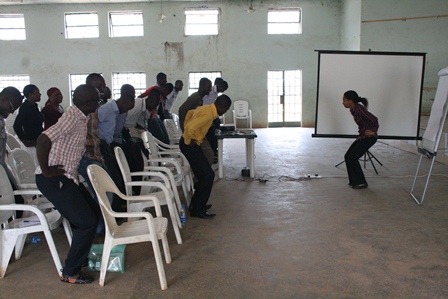
The 20 selected youngsters (3 women and rest men) where eager to learn and very participatory, so the time flew. On Wednesday I had 2 hours planned with small group discussions, educational dialogues and lectures. Two hours to get participants to reflect on their own learning and how they can motivated good learning as teachers. It was exhausting for them and giving me energy. It gave me nough energy to do another 3 hours on Thursday, which I filled with group work and discussions. I organized a carrousel or busstop system so all participants were able to go through all assignments. It was a day to get them to think about different ways of teaching, about different seating arrangements and about their own way of addressing pupils. I think it was a success although this day was even more exhausting for the participants. I keep admiring how Nigerians can concentrate for long periods at the time. Maybe that is a good thing about the teaching style here. Everybody learns to adjust to the lecturer. I hope the photo’s give a little idea about the workshops.
My workshops about teaching were not the only thinks going on on those days; Mrs Awakassien, Chinwe and Victoria also had to take parts of the workshop. Issues as volunteering, the programme and inclusion where addressed by them.


Wednesday, August 10, 2011

Lost in time


This whole week I’m involved in the assessment and basic training of new national volunteers. It’s a nice process to be involved in. It is good to see 30 young persons (between 25 and 34) enthousiastic about helping others in their own country. During the first day we did a whole day of assessments. NYSC and vso got 12 people to be the assessors, most of them untrained and un-experienced.(I was one fitting into that category.)
A little info about the content: for the people that are international volunteers; it was sort of the same as our assessment to become an international volunteer. For all non-vso people; I cannot exactly tell you what we did because it was the same as our international vso assessment.
I say it was sort of the same, because we now had to assess 30 persons instead of 4 to 7 in a real international assessment setting. So imagine 4 groups of 7 participants doing the ‘production line’ activity, one group after the other. Roughly that would take 30 min per group. So with simple maths you would know 30minx4=2hours. On the agenda it was scheduled for 1 hour.
Then the participants had to take place in a group discussion. The plan was to have 4 groups, we reduced it to 3 to safe some time (as we lost quite a lot of time during the first session). For this session the scheduled time was again 1 hour; the real time needed 3x25min=1hours 15 min, but at least we safed some time, we only  lost 1 hour and 15 min in our schedule. After the lunch the participants needed to write a small essay to check if their language skills are accurate enough to be teachers. This took them 30 min and after the essays the individual interviews were planned.
The assessors were paired up. I was paired up with Giwa, a NYSC guy who also did this for the first time. But we turned out to be a team. I was the main interviewer but he really listened and asked the right deepening questions. This session started when we were scheduled to deliberate on the out-come of all sessionsL.
In the end I started to add all out-comes of all sessions to get a rather objective sight on who we should or should not pick. We had to pick 20 of which maybe only 14 will really get a placement. So to speed up the process we picked the people with the highest score. We shortly (we is Chinwe, ms Awakassien and I) debated on the women issue (one out of four did not belong to the highest scores). But I kept to my pass and I said 75% of the females entered just like that, so don’t bother about 1 that didn’t make it.
Ms Awakassien announced one on one if people were selected or not. (As Dutch and tactless I can be I would have just use the X-factor method; just say which numbers are trough and which not.) But with already 3 hours behind on schedule, we had to do it one on one. It took and other 2 hours. In the end we got in the car around 19.30. I had to be in the office before 7.30 that morning, so you could say it was a long day.  
Sometimes after days like this, I wish Nigerians would be able to plan better, but then again now I have something to write about. Thanks for that.
BTW: I am really pleased with the outcome of the assessments. I really think we got a strong group of new teachers out of this all.

Monday, August 1, 2011

Happy Days!!!?

If this day tells me about the whole week this week then I know I’ll be having fun this weekend no matter what! Manashi just left my office with a big big smile on his face. And I am now typing this with maybe an even bigger smile. After hearing Manashi’s story about his school up in the Hills (read Ogbagi) and all his paper work to get clarification and approval of the community school I asked him if he ever thought about working together with the other Eggon Community school nearby Lafia. Maybe by working together he would be able to get support. Then I told him that I could go to the director of inspectorate to ask if he knew how I or Manashi could best get in touch with that school to talk about collaboration.
I knew the director came from up the hills himself so maybe he could also help in another sympathetic way and he did! Without asking he offered to look at the situation and write a letter of recommendation to the local inspectorate office. He was willing to talk to Manashi (in their local language) and explain clearly about the procedures of becoming a center for the West African Examinations. Really nice! Along the way the director of schools (also Eggon) came in and asked Manashi if he was there during a meeting in which he had to reregister his school for the new system. Manashi told him he attended the meeting too late and did not get any information of what was told during the meeting. It seemed that Manashi was working with the old structure and old papers and nobody in the area office bothered to tell him. So we went back to my office to set a new action plan and I went to the Director of planning and information to get the right form so Manashi could carry it right away whitout first climbing the mountain to get 5000 Naira and come back to collect the form. I explained the situation to the Director and he helped right away!
Never thought that I could have this much impact on Manashi’s life work just by knowing people in the office. All those hours of ‘just talking’ and ‘doing friendly’ where not useless. The network I built finally helped somebody that needed help really bad! Happy Day 1!!!

Tuesday, July 26, 2011

help....... or not

The Ministry of Education in Nasarawa started the preparations for the new strategic plan, the State Educational Sector Plan (SESP) and the State Educational Sector Operational Plan (SESOP). UNICEF is asking different states to do this planning so they have an out-line on which they can base their funding to the states on and to get insight on where different states need to build capacity.
A few weeks ago a colleague of mine asked me if I was willing to join the group to plan this SESP, and I said; ‘yes, of course, whenever I can do something to make education better I will do.’ So a month past without any sign. Then I started asking what was going on and if I could do something already. The director of planning and information told me he would tell me if I would be able to help. Okay so again a few weeks past and I knew already that the time span of this project was till the end of November. So I started asking again how they were thinking of doing all the research needed for the programme before November if they didn’t even start forming a research team yet.
We have to wait till after the next workshop. I was like why would UNICEF plan two workshops 2 months apart from each other and not expect anything to happen in between? But now it is a week before the second workshop and they have a lot to do. They have to form a research group and do a baseline analysis on the education in Nasarawa. Yesterday I was invited to be at the opening of this week; to know more about the process and activities. I was allowed to observe, so I did. And during my observations I saw things that I wanted to question. So I did Question the thing after the workshop in a one-to-one chat with a guy from the federal ministry. He did find my questions reasonable and put them there were they belong, the director of planning and information.
Today on the second day of this workshop, I settled myself in the back of the room just like yesterday and started working on my laptop while waiting for everybody to come in. O yeah one thing that was mentioned yesterday was, Be Rigour (time and deadlines are there to be worked with) In other words be on time and deliver results on time!
Not to day! After agreeing on to start at 9 o’clock this morning, only 4 participants and no organization was on time! Is this leading for the rest of the programme? But I was there five minutes past 9 and I was there till 10 minutes before 10. I was told my presence was not needed anymore. Yesterday I should have seen enough to understand the process and activities. So with other words, the director of planning and information didn’t want me around during de SWOT-analysis. Am I to critical?

Monday, July 25, 2011

same-o same-o......... Still waiting

On days like this (a day of waiting for telephone numbers, permission and a meeting with the PS) I'm often thinking how this programme could get shaped. Almost always I get hopelessly lost in my thoughts about the possibilities, chances and things that go wrong. Every time when I try to shape the project for my own state (Nasarawa) I feel I have to ask and wait for proper information from the layer above. The layer above me is only too busy to provide me with the information I need. There by I sometimes think that the federal layer is not sensible of their importance to the state level. I have to wait for information to be able to arrange things on state level. For example in this period; I want to do preparations for next academic year. For those preparations I need information from different parties:
  • a list of schools and accurate phone numbers from SUBEB and MoE,
  • a definite indication of number of new volunteers  
  • the planning of state level so I can plan my activities around that.
  • The plans they in general have about the programme (because the info about the future keeps changing)
In the meanwhile I’m trying to write a planning with roles and responsibilities with it. I don’t see who is really coordinating this whole project. I know I offered to do it in Nasarawa State, but who is doing is in general? Without a national coordinator it is hard to coordinate stuff on state level unless I start my own thing. Who is keeping everybody involved? I honestly don’t think Chinwe has time enough to coordinate this whole project, I also don’t think Mrs Awakasien has the time and I don’t know anybody else that is involved on state level. Somehow I think the placement Lea and I have is not the right one in this project at the moment. Right now I think this project needs a capacity builder at State level working together with Mrs Awakasien to coordinate this whole programme. For me it feels like: ‘how can an arm function if the head is not there’.
The last time I had this feeling I left it laying aside for too long and waited till I bursted out into tears on the phone with Chinwe. I don’t want that to happen again, but I also don’t want this feeling again. This feeling on waiting for stuff you need and knowing you won’t get it in time. For me time is running out to do the assessments in the schools because schools are closing soon. Also it’s getting really close to the date that was set to have the recruitment week. Still stuff needs to be prepared. I see a lot of work ahead that could have been done a long time ago if the planning was done.
On top of this all, I saw on www.nysccds.org that the programme will be expanded to Jigawa, while in a stakeholders meeting before this launch we decided not to expend to other states and decreasing the number of schools. Thereby Lea told me he will retire from this work in December. How will do his work in Kwara? How will pick up the work in Kano?
For your eyes I may probably see to many lions on the road, but for me it really hinders me in getting my mind set to get to the job I’m here for. I feel I cannot face my national volunteers while the programme feels like a mess. Every time when I see them or speak to them they ask me stuff and I have to tell them I don’t know. That doesn’t feel right.
As I just wrote in the third section one of the solutions I can think of is a capacity builder in NYSC Headquarters to help coordinating this project. This only works if NYSC agrees that they are the leading party in this. If not VSOVSO to handle. That other partner could be a new NGO especially developed for national volunteering or an existing one that wants to partner up. Or VSO needs to great a new PM-job to manage all national volunteering within VSO organisations. This last idea will fit into the new strategic plan (if VSO international agrees on these plans). The last solution can be to have this programme on a small scale and have an international volunteer manage the project.
I don’t want to be to negative and I want to keep thinking about the chances this project has, but for now I feel useless and am (for the second time this month) thinking of going home if nothing is changing soon. It was wrong to invite Lea and me for these placements and just let us do anything we would feel like. This did result in Lea only working for 40% in this project and me searching for any other work I can find (organizing workshops which are not really in my job description, taking part in strategic planning, initiating stakeholders meeting, ordering you all around).
By rereading this blog/letter I realize that the biggest problem for me is that I am a team player and I don’t function very well when I cannot share thoughts. I need somebody or a team to crystallise ideas and shape them together with others. Is this then my downfall? Can I change my way of working? Do I want to change my favourite way of working? I don’t know I think it is one of the basics of VSO, Sharing skills tells me that I have to work together with others. There is nobody to share something with. Or is this the main reason why VSO changed their motto into ‘People first’? with this motto you don’t have to share explicitly anymore.

Friday, June 24, 2011

Challenges


Everybody that got to know me a little bit better, know that I won’t bounce back on a challenge that easy. Why would I be here? A challenge makes me fight and work hard to make it work, even when others don’t see it happen anymore. This is the case with my job here in Nigeria. Since October 2010 I’m here to fulfil a job as teacher trainer for National volunteers who are not trained to be teachers. On itself already a challenge as I think being a teacher is not just something you do, you really need to learn how to coop with situations and how to transfer knowledge in an effective way.
I was not the only one entering this country with this particular placement description, a volunteer from the UK, has had the same challenges since October in Kwara State. He did not see the bright light at the end of the tunnel like I see it. He saw the same chaos…… working without a real plan ….. inventing a wheel without resources. Maybe he was the smart one. I sometimes think; ‘Maybe I also should think about changing my placement in something less stressful and more structured.’ He left the placement partly and is now working in a more lined out placement in Kwara.
I stayed because I believed and I still belief in the power of this project. I stayed to fight for the national volunteers I work for. I wanted to see how I can make this work in Nassarawa State. But ever since I started fighting for this project the light at the end of the tunnel doesn’t get brighter of bigger. It stays far away out of reach. How long can I keep working in this situation without getting stressed out by frustrations?
I’ve been shouting and crying for a stakeholders meeting about this whole programme. I’ve threatened to leave the country if the stakeholder meeting wasn’t arranged before March. Somehow I didn’t leave and I agreed on a meeting after my trip to The Netherlands, so date was set in June, last Tuesday to be exact. Finally my meeting about goals and objectives, I thought. All stakeholders in Nassarawa state were invited; also some potential new stakeholders were there.
The evening before the meeting Yakiem, Chinwe, Lucy and I met to do the last preparations for the meeting. Then I discovered that the content of the meeting as planned was not as promising as I hoped it would be. It was more about brainstorming instead of making plans. Then we had to prepare our own parts and I had to prepare the bit about objectives and I knew I had to do that bit, but in my head I did a different kind of session about objectives. In my head I planned a SWOT-analyses and after that try to generate new objectives with the outcome. Now I had only 20 minutes! That’s no time to write new objectives with a group of 20 participants! So I organized in inventory session about new possible objectives.
So during the meeting with all important stakeholders present we were only brainstorming about the future of the programme. No real decisions were made. The only real decision I forced was that I will be the project manager for the NGVP in Nassarawa state. The rest of the outcome is more or less caught by the words; We could do. …… We should do……. Maybe………. Possibly……. For me for now empty words. So I will start shouting again for a follow up in which really agreements are signed with a real placement agreement in the end of it. Best thing about that meeting will be that I’m the one able to initiate it as the project manager.

Friday, June 3, 2011

Nigerian children are different .......

Last week in Azara I prepared a whole day workshop about classroom management and teaching aids. During the preparations for this workshop it became even clearer to me that there are a lot of cultural influences in how we look at children and their capabilities. I also noticed some of the mistakes I made during my first workshop here in Nigeria in December 2010; I was thinking too much out of my own perspective of what is good teaching and effective learning. During my 7 month here in Nigeria I now learned to look through a Nigeria perspective with my own vision on education. So I can combine my own thoughts with the current situation here. 
I could really notice a difference in interaction between me and the group of teachers that I was trying to reach. I could talk out of my own experiences and from what I have seen during my school visits in the past months. Some of the big differences in my own perspective on teaching and learning and how to react to a adolescent are; 
  1. In The Netherlands I would encourage the adolescent to make their own decisions, and let them meet their own mistakes and reflect on that. Here teachers are not yet used to talk to an adolescent like they can make decisions, so they did not learn to coop with the possibility of making decisions.  
  2. During the workshop in Azara we were talking about classroom rules and consequences (at least that’s how I introduced the session). Everybody had to list his/her classroom rules and make a list of top 6 consequences. Consequences are called punishment here in Nigeria. Some examples of punishments that are used by teachers in Azara: standing up in the classroom for about 5 minutes, kneeling down in the classroom, turning your face from the board for the rest of the lesson, send out of the classroom, kneeling down outside for 20 minutes, do frog jumping on school premises.  
  3.  In The Netherlands we are more and more about involving pupils into the lesson and letting them find out what they need to learn before they can make the next step. Here in Nigeria all the lessons are like lectures without books. All a pupil does is listening. Most of the time the pupils are not allowed to write during the lectures because that will distract him/her. Some other moment in the week the pupils will have to write the notes in their notebooks. The teacher is writing everything on the blackboard without explaining anything because he/she already did that in a previous lesson or will do in a following lesson. During the workshop we had a discussion about evolving skills in the classroom; When do pupils have to learn skills they need to be successful in tertiary education? What are skills they need? Listening and writing at the same time is one of those skills you need to train in the classroom. You can’t just expect them to be there after secondary school. It is the teachers/schools responsibility to know which skills and to teach those skills which pupils need before going to tertiary school. 
  4. In The Netherlands child-centered teaching is important and for that classroom shouldn’t be too crowded. A Dutch teacher will start to complain when there are more than 27 pupils in his/her classroom. In some schools maybe already when there are 25 pupils packing your classroom.  Here I introduced activated teaching because classrooms are more often packed with 70 pupils, with which it would be too big a challenge to do real child-centered learning. Activating teaching is about little things you can do to get the pupils more involved during the lessons. Little bit on how to ask real questions to a classroom and how to force pupils to think about an answer. 
  5. During teacher training college in The Netherlands you learn a lot about child psychology and sociology and other things you need to understand if you work with other people. I think it is important for a teacher to know with whom he/she has to deal with. But it is maybe more important to recognize the individual pupils in your classroom. I know that I wasn’t the best in learning names by heart, but I always knew particular thing about my pupils, Hobby’s, relations, relatives, anything. During the workshop, but also during other school visits I noticed that a lot of the teachers don’t really know what is going on in the lives of the pupils. It like they don’t seem to care. Everybody needs to act the same and if you act differently teachers don’t know what to do and you will have the change to be hit with a thin branch or ruler. It’s is really sad to see that some adolescents just are exploring (something they need to do) and then been hit with a branch or ruler. Even though corporal punishment is forbidden in Nassarawa State.When I did talk about this with teachers during the workshop they really didn’t know how to act differently. When I told them that in The Netherlands children aren’t saints and they will try everything they can to dodge school or to do anything against the rules, they look at me with big eyes: ‘How do you correct them if you aren’t allowed to touch them?’ ‘You will have to talk some sense into them, talk about decent behaviour and why there are rules. Then let them do some work as a consequence for his/her actions.’ That was something that was impossible with an African child, they all said. 'Our children are different, they don't listen if you don't teach them the hard way.' I was so surprised by that answer. I said: ‘They are not used to it yet because at home they are also beaten when they aren’t acting as they should do according to their parents, but somebody has to start making a change!’ Luckely lot of them agreed on that.